The history of Christmas

Christmas is celebrated on December 25 and is both a sacred religious holiday and a worldwide cultural and commercial phenomenon. For two millennia, people around the world have been observing it with traditions and practices that are both religious and secular in nature. Christians celebrate Christmas Day as the anniversary of the birth of Jesus of Nazareth, a spiritual leader whose teachings form the basis of their religion. Popular customs include exchanging gifts, decorating Christmas trees, attending church, sharing meals with family and friends and, of course, waiting for Santa Claus to arrive. December 25–Christmas Day–has been a federal holiday in the United States since 1870.

Image result for christmas

How Did Christmas Start?

The middle of winter has long been a time of celebration around the world. Centuries before the arrival of the man called Jesus, early Europeans celebrated light and birth in the darkest days of winter. Many peoples rejoiced during the winter solstice, when the worst of the winter was behind them and they could look forward to longer days and extended hours of sunlight.

In Scandinavia, the Norse celebrated Yule from December 21, the winter solstice, through January. In recognition of the return of the sun, fathers and sons would bring home large logs, which they would set on fire. The people would feast until the log burned out, which could take as many as 12 days. The Norse believed that each spark from the fire represented a new pig or calf that would be born during the coming year.

The end of December was a perfect time for celebration in most areas of Europe. At that time of year, most cattle were slaughtered so they would not have to be fed during the winter. For many, it was the only time of year when they had a supply of fresh meat. In addition, most wine and beer made during the year was finally fermented and ready for drinking.

In Germany, people honored the pagan god Oden during the mid-winter holiday. Germans were terrified of Oden, as they believed he made nocturnal flights through the sky to observe his people, and then decide who would prosper or perish. Because of his presence, many people chose to stay inside.

Saturnalia

In Rome, where winters were not as harsh as those in the far north, Saturnalia—a holiday in honor of Saturn, the god of agriculture—was celebrated. Beginning in the week leading up to the winter solstice and continuing for a full month, Saturnalia was a hedonistic time, when food and drink were plentiful and the normal Roman social order was turned upside down. For a month, slaves would become masters. Peasants were in command of the city. Business and schools were closed so that everyone could join in the fun.

Also around the time of the winter solstice, Romans observed Juvenalia, a feast honoring the children of Rome. In addition, members of the upper classes often celebrated the birthday of Mithra, the god of the unconquerable sun, on December 25. It was believed that Mithra, an infant god, was born of a rock. For some Romans, Mithra’s birthday was the most sacred day of the year.

Is Christmas Really the Day Jesus Was Born?

In the early years of Christianity, Easter was the main holiday; the birth of Jesus was not celebrated. In the fourth century, church officials decided to institute the birth of Jesus as a holiday. Unfortunately, the Bible does not mention date for his birth (a fact Puritans later pointed out in order to deny the legitimacy of the celebration). Although some evidence suggests that his birth may have occurred in the spring (why would shepherds be herding in the middle of winter?), Pope Julius I chose December 25. It is commonly believed that the church chose this date in an effort to adopt and absorb the traditions of the pagan Saturnalia festival. First called the Feast of the Nativity, the custom spread to Egypt by 432 and to England by the end of the sixth century. 

By the end of the eighth century, the celebration of Christmas had spread all the way to Scandinavia. Today, in the Greek and Russian orthodox churches, Christmas is celebrated 13 to 14 days after the 25th. This is because Western churches use the Gregorian Calendar, while Eastern Churches use the Julian Calendar, which is 13 to 14 days behind the Gregorian Calendar. Both Western and Eastern churches celebrate Epiphany or Three Kings Day 12 days after their own respective Christmases. This is the day it is believed that the three wise men finally found Jesus in the manger.

By holding Christmas at the same time as traditional winter solstice festivals, church leaders increased the chances that Christmas would be popularly embraced, but gave up the ability to dictate how it was celebrated. By the Middle Ages, Christianity had, for the most part, replaced pagan religion. On Christmas, believers attended church, then celebrated raucously in a drunken, carnival-like atmosphere similar to today’s Mardi Gras. Each year, a beggar or student would be crowned the “lord of misrule” and eager celebrants played the part of his subjects. The poor would go to the houses of the rich and demand their best food and drink. If owners failed to comply, their visitors would most likely terrorize them with mischief. Christmas became the time of year when the upper classes could repay their real or imagined “debt” to society by entertaining less fortunate citizens.

When Christmas Was Cancelled

In the early 17th century, a wave of religious reform changed the way Christmas was celebrated in Europe. When Oliver Cromwell and his Puritan forces took over England in 1645, they vowed to rid England of decadence and, as part of their effort, cancelled Christmas. By popular demand, Charles II was restored to the throne and, with him, came the return of the popular holiday.

The pilgrims, English separatists that came to America in 1620, were even more orthodox in their Puritan beliefs than Cromwell. As a result, Christmas was not a holiday in early America. From 1659 to 1681, the celebration of Christmas was actually outlawed in Boston. Anyone exhibiting the Christmas spirit was fined five shillings. By contrast, in the Jamestown settlement, Captain John Smith reported that Christmas was enjoyed by all and passed without incident.

After the American Revolution, English customs fell out of favor, including Christmas. In fact, Christmas wasn’t declared a federal holiday until June 26, 1870.

Washington Irving Reinvents Christmas

It wasn’t until the 19th century that Americans began to embrace Christmas. Americans re-invented Christmas, and changed it from a raucous carnival holiday into a family-centered day of peace and nostalgia. But what about the 1800s piqued American interest in the holiday?

The early 19th century was a period of class conflict and turmoil. During this time, unemployment was high and gang rioting by the disenchanted classes often occurred during the Christmas season. In 1828, the New York city council instituted the city’s first police force in response to a Christmas riot. This catalyzed certain members of the upper classes to begin to change the way Christmas was celebrated in America.

In 1819, best-selling author Washington Irving wrote The Sketchbook of Geoffrey Crayon, gent., a series of stories about the celebration of Christmas in an English manor house. The sketches feature a squire who invited the peasants into his home for the holiday. In contrast to the problems faced in American society, the two groups mingled effortlessly. In Irving’s mind, Christmas should be a peaceful, warm-hearted holiday bringing groups together across lines of wealth or social status. Irving’s fictitious celebrants enjoyed “ancient customs,” including the crowning of a Lord of Misrule. Irving’s book, however, was not based on any holiday celebration he had attended – in fact, many historians say that Irving’s account actually “invented” tradition by implying that it described the true customs of the season.

A Christmas Carol

Also around this time, English author Charles Dickens created the classic holiday tale, A Christmas Carol. The story’s message-the importance of charity and good will towards all humankind-struck a powerful chord in the United States and England and showed members of Victorian society the benefits of celebrating the holiday.

The family was also becoming less disciplined and more sensitive to the emotional needs of children during the early 1800s. Christmas provided families with a day when they could lavish attention-and gifts-on their children without appearing to “spoil” them.

10 history facts you never learned in school

As the old saying goes, “Those who don’t know history are doomed to repeat it.” (Or something like that). Yes, it’s important to know your history—not just the big names and key dates, but the little details that help us better understand a historic figure or era in which they lived. Maybe it’s a surprising fact that makes you rethink conventional wisdom. Maybe it’s a wild anecdote that seems too crazy to be true. Whatever the case, it’s the little, surprising bits of history are perhaps the most fun bits of history—the type of info that’s so wacky and out there it could never be repeated even if someone wanted to. Here are 10 such tidbits, in no particular order.

1 Turkeys Were Once Worshipped Like Gods

turkey historical facts
Shutterstock

While the turkey is currently America’s favorite part of the Thanksgiving meal, in 300 B.C., these big birds were heralded by the Mayan people as vessels of the gods and were honored as such, so much so that they were domesticated to have roles in religious rites. They were symbols of power and prestige and can be found everywhere in Maya iconography and archaeology.

2 Paul Revere Never Actually Shouted, “The British Are Coming!”

Paul Revere historical facts

While everyone knows the story of Revere’s famous ride in which he was said to have warned colonial militia of the approaching enemy by yelling “The British are coming!” This is actually false. According to History.com, the operation was meant to be quiet and stealthy, since British troops were hiding out in the Massachusetts countryside. Also, colonial Americans still considered themselves to be British.

3 The Olympics Used to Award Medals for Art.

Woman at the Olympics historical facts
Shutterstock

From 1912 to 1948, the Olympic Games held competitions in the fine arts. Medals were given for literature, architecture, sculpture, painting, and music. Naturally, the art created was required to be Olympic-themed. According to the founder of the modern Olympics, Pierre de Frédy, the addition of the arts was necessary because the ancient Greeks used to hold art festivals alongside the games. Before the art events were eventually removed, 151 medals were awarded.

4 One Time, 100 Imposters Claimed to Be Marie Antoinette’s Dead Son

Louis XVII historical facts
Image via Wikimedia Commons

After the French Revolution, eight-year-old Louis XVII was imprisoned and then never seen in public ever again. His parents were executed in 1793 and, afterward, he was horrifically abused, neglected, and left isolated in a prison cell in the Paris Temple. In 1795, he died of Tuberculous at 10-years-old. His body was buried in secret in a mass grave. Years later, dozens of men came forward claiming to be him because a Bourbon restoration was a possibility and a successful claimant could then potentially find himself on the throne of France.

5 Napoleon Was Once Attacked By a Horde of Bunnies

Napoleon Bonaparte historical facts
Shutterstock

Once upon a time, the famous conqueror Napoleon Bonaparte was attacked by…bunnies. The emperor had requested that a rabbit hunt be arranged for himself and his men. His chief of staff set it up and had men round up reportedly 3,000 rabbits for the occasion. When the rabbits were released from their cages, the hunt was ready to go. At least that was the plan! But the bunnies charged toward Bonaparte and his men in a viscous and unstoppable onslaught. And we were taught that Waterloo was the conqueror’s greatest defeat…

6 Women Were Once Banned from Smoking in Public

Sullivan Ordinance historical facts
Image via Wikimedia Commons

In 1908, New Yorker Katie Mulcahey was arrested for striking a match against a wall and lighting a cigarette with it. Why? Because this was a violation of The Sullivan Ordinance, a city law banning women (and only women!) from smoking in public. During her hearing at the district court, Mulcahey argued about her rights to smoke cigarettes in public. She was fined $5.00. Two weeks later, The Sullivan Ordinance was vetoed by New York City’s mayor.

7 The Government Literally Poisoned Alcohol During Prohibition

Prohibition during the 1920s historical facts
Image via Wikimedia Commons

During Prohibition in the United States, the U.S. government literally poisoned alcohol. When people continued to consume alcohol despite its banning, law officials got frustrated and decided to try a different kind of deterrent—death. They ordered the poisoning of industrial alcohols manufactured in the U.S., which were products regularly stolen bootleggers. By the end of Prohibition in 1933, the federal poisoning program is estimated to have killed at least 10,000 people.

8 Captain Morgan Actually Existed

captain morgan historical facts

Yes, face of the well-loved rum brand was a totally real guy. He was a Welsh privateer who fought alongside the English against the Spanish in the Caribbean in the 1660s and 1670s. His first name was Henry and was knighted by King Charles II of England. His exact birth date is unknown, but it was sometime around 1635. He died in Jamaica in 1688, apparently very rich.

9 Using Forks Used to Be Seen as Sacrilegious

forks historical facts
Shutterstock

What the fork? Forks, the widely used eating utensils, were once seen as blasphemous. They were first introduced in Italy in the 11th Century. These spiked spaghetti-twirling instruments were seen as an offense to God. And why, do you ask? Because they were “artificial hands” and as such was considered to be sacrilegious.

10 The Titanic‘s Owners Never Said the Ship Was “Unsinkable”

titanic historical facts

Despite what James Cameron’s iconic 1997 film may have you believe, the owners never said that it could never sink. Historian Richard Howells said that “the population as a whole were unlikely to have thought of the Titanic as a unique, unsinkable ship before its maiden voyage.”

The Black Death

Between 1347 and 1350, a mysterious disease known as the ” Black Death ” (the bubonic plague) killed some 20 million people in Europe—30 percent of the continent’s population. It was especially deadly in cities, where it was impossible to prevent the transmission of the disease from one person to another.

Image result for the black death

The plague started in Europe in October 1347, when 12 ships from the Black Sea docked at the Sicilian port of Messina. Most sailors aboard the ships were dead, and those who were alive were covered in black boils that oozed blood and pus. Symptoms of the Black Death included fever, chills, vomiting, diarrhea, terrible aches and pains – and then death. Victims could go to bed feeling healthy and be dead by morning.

The plague killed cows, pigs, goats, chickens and even sheep, leading to a wool shortage in Europe. Understandably terrified about the mysterious disease, some people of the Middle Ages believed the plague was a divine punishment for sin. To obtain forgiveness, some people became “flagellants,” traveling Europe to put on public displays of penance that could include whipping and beating one another. Others turned on their neighbors, purging people they believed to be heretics. Thousands of Jews were murdered between 1348 and 1349, while others fled to less populated areas of Eastern Europe.

Today, scientists know the plague was caused by a bacillus called Yersina pestis, which travels through the air and can also be contracted through the bite of an infected flea or rat, both of which were common in the Middle Ages, especially on ships. 

The Middle Ages

People use the phrase “Middle Ages” to describe Europe between the fall of Rome in 476 CE and the beginning of the Renaissance in the 14th century. Many scholars call the era the “medieval period” instead; “Middle Ages,” they say, incorrectly implies that the period is an insignificant blip sandwiched between two much more important epochs.

The Middle Ages: Birth of an Idea

The phrase “Middle Ages” tells us more about the Renaissance that followed it than it does about the era itself. Starting around the 14th century, European thinkers, writers and artists began to look back and celebrate the art and culture of ancient Greece and Rome. Accordingly, they dismissed the period after the fall of Rome as a “Middle” or even “Dark” age in which no scientific accomplishments had been made, no great art produced, no great leaders born. The people of the Middle Ages had squandered the advancements of their predecessors, this argument went, and mired themselves instead in what 18th-century English historian Edward Gibbon called “barbarism and religion.”

Did you know? Between 1347 and 1350, a mysterious disease known as the “Black Death” (the bubonic plague) killed some 20 million people in Europe—30 percent of the continent’s population. It was especially deadly in cities, where it was impossible to prevent the transmission of the disease from one person to another.

This way of thinking about the era in the “middle” of the fall of Rome and the rise of the Renaissance prevailed until relatively recently. However, today’s scholars note that the era was as complex and vibrant as any other.

The Catholic Church in the Middle Ages

After the fall of Rome, no single state or government united the people who lived on the European continent. Instead, the Catholic Church became the most powerful institution of the medieval period. Kings, queens and other leaders derived much of their power from their alliances with and protection of the Church.

In 800 CE, for example, Pope Leo III named the Frankish king Charlemagne the “Emperor of the Romans”–the first since that empire’s fall more than 300 years before. Over time, Charlemagne’s realm became the Holy Roman Empire, one of several political entities in Europe whose interests tended to align with those of the Church.

Ordinary people across Europe had to “tithe” 10 percent of their earnings each year to the Church; at the same time, the Church was mostly exempt from taxation. These policies helped it to amass a great deal of money and power.

The Middle Ages: The Rise of Islam

Meanwhile, the Islamic world was growing larger and more powerful. After the prophet Muhammad’s death in 632 CE, Muslim armies conquered large parts of the Middle East, uniting them under the rule of a single caliph. At its height, the medieval Islamic world was more than three times bigger than all of Christendom.

Under the caliphs, great cities such as Cairo, Baghdad and Damascus fostered a vibrant intellectual and cultural life. Poets, scientists and philosophers wrote thousands of books (on paper, a Chinese invention that had made its way into the Islamic world by the 8th century). Scholars translated Greek, Iranian and Indian texts into Arabic. Inventors devised technologies like the pinhole camera, soap, windmills, surgical instruments, an early flying machine and the system of numerals that we use today. And religious scholars and mystics translated, interpreted and taught the Quran and other scriptural texts to people across the Middle East.

The Crusades

Toward the end of the 11th century, the Catholic Church began to authorize military expeditions, or Crusades, to expel Muslim “infidels” from the Holy Land. Crusaders, who wore red crosses on their coats to advertise their status, believed that their service would guarantee the remission of their sins and ensure that they could spend all eternity in Heaven. (They also received more worldly rewards, such as papal protection of their property and forgiveness of some kinds of loan payments.)

The Crusades began in 1095, when Pope Urban summoned a Christian army to fight its way to Jerusalem, and continued on and off until the end of the 15th century. In 1099, Christian armies captured Jerusalem from Muslim control, and groups of pilgrims from across Western Europe started visiting the Holy Land. Many of them, however, were robbed and killed as they crossed through Muslim-controlled territories during their journey.

Around 1118, a French knight named Hugues de Payens created a military order along with eight relatives and acquaintances that became the Knights Templar, and they won the eventual support of the pope and a reputation for being fearsome fighters. The Fall of Acre in 1291 marked the destruction of the last remaining Crusader refuge in the Holy Land, and Pope Clement V dissolved the Knights Templar in 1312.

No one “won” the Crusades; in fact, many thousands of people from both sides lost their lives. They did make ordinary Catholics across Christendom feel like they had a common purpose, and they inspired waves of religious enthusiasm among people who might otherwise have felt alienated from the official Church. They also exposed Crusaders to Islamic literature, science and technology–exposure that would have a lasting effect on European intellectual life.

The Middle Ages: Art and Architecture

Another way to show devotion to the Church was to build grand cathedrals and other ecclesiastical structures such as monasteries. Cathedrals were the largest buildings in medieval Europe, and they could be found at the center of towns and cities across the continent.

Between the 10th and 13th centuries, most European cathedrals were built in the Romanesque style. Romanesque cathedrals are solid and substantial: They have rounded masonry arches and barrel vaults supporting the roof, thick stone walls and few windows. (Examples of Romanesque architecture include the Porto Cathedral in Portugal and the Speyer Cathedral in present-day Germany.)

Around 1200, church builders began to embrace a new architectural style, known as the Gothic. Gothic structures, such as the Abbey Church of Saint-Denis in France and the rebuilt Canterbury Cathedral in England, have huge stained-glass windows, pointed vaults and arches (a technology developed in the Islamic world), and spires and flying buttresses. In contrast to heavy Romanesque buildings, Gothic architecture seems to be almost weightless. Medieval religious art took other forms as well. Frescoes and mosaics decorated church interiors, and artists painted devotional images of the Virgin Mary, Jesus and the saints.

Ancient India

India is a country in South Asia whose name comes from the Indus River. The name ‘Bharata’ is used as a designation for the country in their constitution referencing the ancient mythological emperor, Bharata, whose story is told, in part, in the Indian epic Mahabharata. According to the writings known as the Puranas (religious/historical texts written down in the 5th century CE), Bharata conquered the whole subcontinent of India and ruled the land in peace and harmony. The land was, therefore, known as Bharatavarsha (`the subcontinent of Bharata’). Hominid activity in the Indian subcontinent stretches back over 250,000 years, and it is, therefore, one of the oldest inhabited regions on the planet.

Archaeological excavations have discovered artifacts used by early humans, including stone tools, which suggest an extremely early date for human habitation and technology in the area. While the civilizations of Mesopotamia and Egypt have long been recognized for their celebrated contributions to civilization, India has often been overlooked, especially in the West, though its history and culture is just as rich.

Prehistory of India

The areas of present-day India, Pakistan, and Nepal have provided archaeologists and scholars with the richest sites of the most ancient pedigree. The species Homo heidelbergensis (a proto-human who was an ancestor of modern Homo sapiens) inhabited the subcontinent of India centuries before humans migrated into the region known as Europe. Evidence of the existence of Homo heidelbergensis was first discovered in Germany in 1907 CE and, since, further discoveries have established fairly clear migration patterns of this species out of Africa. Recognition of the antiquity of their presence in India has been largely due to the fairly late archaeological interest in the area as, unlike work in Mesopotamia and Egypt, western excavations in India did not begin in earnest until the 1920s CE. Though the ancient city of Harappa was known to exist as early as 1842 CE, its archaeological significance was ignored and the later excavations corresponded to an interest in locating the probable sites referred to in the great Indian epics Mahabharata and Ramayana (both of the 5th or 4th centuries BCE) while ignoring the possibility of a much more ancient past for the region. The village of Balathal (near Udaipur in Rajasthan), to cite only one example, illustrates the antiquity of India’s history as it dates to 4000 BCE. Balathal was not discovered until 1962 CE and excavations were not begun there until the 1990s CE.ARCHAEOLOGICAL EXCAVATIONS IN THE PAST 50 YEARS HAVE DRAMATICALLY CHANGED THE UNDERSTANDING OF INDIA’S PAST &, BY EXTENSION, WORLD HISTORY.

Archaeological excavations in the past 50 years have dramatically changed the understanding of India’s past and, by extension, world history. A 4000-year-old skeleton discovered at Balathal in 2009 CE provides the oldest evidence of leprosy in India. Prior to this find, leprosy was considered a much younger disease thought to have been carried from Africa to India at some point and then from India to Europe by the army of Alexander the Great following his death in 323 BCE. It is now understood that significant human activity was underway in India by the Holocene Period (10,000 years ago) and that many historical assumptions based upon earlier work in Egypt and Mesopotamia, need to be reviewed and revised. The beginnings of the Vedic tradition in India, still practiced today, can now be dated, at least in part, to the indigenous people of ancient sites such as Balathal rather than, as often claimed, wholly to the Aryan invasion of c. 1500 BCE.

Mohenjo-Daro & Harappan Civilization

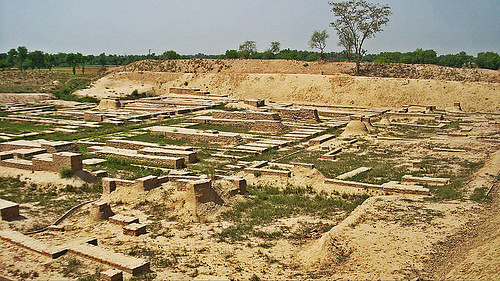
The Indus Valley Civilization dates to 5000 BCE and grew steadily throughout the lower Gangetic Valley region southwards and northwards to Malwa. The cities of this period were larger than contemporary settlements in other countries, were situated according to cardinal points, and were built of mud bricks, often kiln-fired. Houses were constructed with a large courtyard opening from the front door, a kitchen/workroom for the preparation of food, and smaller bedrooms. Family activities seem to have centered on the front of the house, particularly the courtyard and, in this, are similar to what has been inferred from sites in Rome, Egypt, Greece, and Mesopotamia.

Excavation site at Mohenjo-daro

The most famous sites of this period are the great cities of Mohenjo-Daro and Harappa both located in present-day Pakistan (Mohenjo-Daro in the Sindh province and Harappa in Punjab) which was part of India until the 1947 CE partition of the country which created the separate nation. Harappa has given its name to the Harappan Civilization (another name for the Indus Valley Civilization) which is usually divided into Early, Middle, and Mature periods corresponding roughly to 5000-4000 BCE (Early), 4000-2900 BCE (Middle), and 2900-1900 BCE (Mature). Harappa dates from the Middle period (c. 3000 BCE) while Mohenjo-Daro was built in the Mature period (c. 2600 BCE).

Harappa was largely destroyed in the 19th century CE when British workers carried away much of the city for use as ballast in constructing the railroad and many buildings had already been dismantled by citizens of the local village of Harappa (which gives the site its name) for use in their own projects. It is therefore now difficult to determine the historical significance of Harappa save that it is clear it was once a significant Bronze Age community with a population of as many as 30,000 people. Mohenjo-Daro, on the other hand, is much better preserved as it lay mostly buried until 1922 CE. The name `Mohenjo-Daro’ means `mound of the dead’ in Sindhi. The original name of the city is unknown although various possibilities have been suggested by finds in the region, among them, the Dravidian name `Kukkutarma’, the city of the cock, a possible allusion to the site as a center of ritual cock-fighting or, perhaps, as a breeding center for cocks.

Mohenjo-Daro was an elaborately constructed city with streets laid out evenly at right angles and a sophisticated drainage system. The Great Bath, a central structure at the site, was heated and seems to have been a focal point for the community. The citizens were skilled in the use of metals such as copperbronze, lead, and tin (as evidenced by artworks such as the bronze statue of the Dancing Girl and by individual seals) and cultivated barley, wheat, peas, sesame, and cotton. Trade was an important source of commerce and it is thought that ancient Mesopotamian texts which mention Magan and Meluhha refer to India generally or, perhaps, Mohenjo-Daro specifically. Artifacts from the Indus Valley region have been found at sites in Mesopotamia though their precise point of origin in India is not always clear.

Harappa Ruins

Ancient Japan

Ancient Japan has made unique contributions to world culture which include the Shinto religion and its architecture, distinctive art objects such as haniwa figurines, the oldest pottery vessels in the world, the largest wooden buildings anywhere at their time of construction, and many literary classics including the world’s first novel. Although Japan was significantly influenced by China and Korea, the islands were never subject to foreign political control and so were free to select those ideas which appealed to them, adapt them how they wished, and to continue with their indigenous cultural practices to create a unique approach to government, religion, and the arts.

Japan in Mythology

In Shinto mythology, the Japanese islands were created by the gods Izanami and Izanagi when they dipped a jewelled spear into the primordial sea. They also created over 800 kami or spirits, chief amongst which was the sun goddess Amaterasu, and so created the deities of Shinto, the indigenous religion of ancient Japan. Amaterasu’s grandson Ninigi became the first ruler, and he was the great-grandfather of Japan’s first emperor, the semi-legendary Emperor Jimmu (r. 660-585 BCE). Thus, a divine link was established between all subsequent emperors and the gods.

The Jomon Period 

The first historical period of Japan is the Jomon Period which covers c. 14,500 to c. 300 BCE (although both the start and end dates for this period are disputed). The period’s name derives from the distinctive pottery produced at that time, the oldest vessels in the world, which has simple rope-like decoration or jomon. It is the appearance of this pottery that marks the end of the previous period, the Palaeolithic Age (30,000 years ago) when people crossed now lost land bridges from mainland Asia to the northern and southern Japanese islands. They then spread to the four main islands of Hokkaido, Honshu, Shikoku and Kyushu, and eventually to the several hundred smaller islands that make up Japan. The production of pottery does not necessarily signify communities lived in fixed settlements, and for the majority of this time period, people would have continued to live a hunter-gatherer existence using wood and stone tools. THE FIRST SIGNS OF AGRICULTURE APPEAR C. 5000 BCE & THE EARLIEST KNOWN SETTLEMENT AT SANNAI-MARUYAMA DATES TO C. 3500 BCE. 

The first signs of agriculture appear c. 5000 BCE and the earliest known settlement at Sannai-Maruyama dates to c. 3500 BCE and lasts until c. 2000 BCE. Populations seem to have concentrated in coastal areas and numbered somewhere between 100,000 and 150,000 across the islands. There is evidence of rice c. 1250 BCE, but its cultivation was likely not until c. 800 BCE. The first evidence of growing rice in wet fields dates to c. 600 BCE. Skeletons from the period indicate people of muscular build with wide square faces and an average height of 1.52 m (5 ft) for females and 1.60 m (5 ft 3 inches) for males. Genetic and cranial studies suggest that Jomon people are the ancestors of the present-day minority group, the Ainu.   

The most common burial type of the period is in pits, sometimes lined with stone slabs, which contain one or more individuals. Other types of burial include single individuals in jars and large pits containing up to 100 skeletons. Artefacts discovered relating to the Jomon Period include clay and stone human-shaped figurines, clay masks, stone rods, and clay, stone, and jade jewellery (beads and earrings). Archaeology has also revealed the Jomon built ritual structures of stone circles, lines of stones forming arrow shapes, and single tall standing stones surrounded by a cluster of smaller stones. 

Jomon Spouted Vessel

The Yayoi Period 

The Yayoi Period covers c. 300 BCE to c. 250 CE, although, as mentioned above, the start date is being pushed back as more discoveries are made in archaeology. The name derives from the reddish pottery first found in the Yayoi district of Tokyo, which indicated a development from the pottery of the Jomon Period. From around 400 BCE (or even earlier) migrants began to arrive from continental Asia, especially the Korean peninsula, probably driven by the wars caused by Chinese expansion and between rival kingdoms. 

The new arrivals conquered or integrated with the indigenous peoples, as indicated by genetic evidence, and they brought with them new pottery, bronze, iron and improved metalworking techniques which produced more efficient farming tools and better weaponry and armour. 

With improved agricultural management, society was able to develop with specialised trades and professions (and consequent markets for trade appeared), ritual practices using such distinctive items as dotaku bronze bells, social classes of varying prosperity, and an established ruling class who governed over alliances of clan groups which eventually formed small kingdoms. Chinese sources note the frequency of warfare in Japan between rival kingdoms, and archaeology has revealed the remains of fortified villages. The population of Japan by the end of the period may have been as high as 4.5 million.   

Yayoi Period Bracelet

Japan was beginning its first attempts at international relations by the end of the period. Envoys and tribute were sent to the Chinese commanderies in northern Korea by the Wa, as the confederation of small states in southern and western Japan were then known, the most important of which was Yamato. These missions are recorded in 57 and 107 CE. One Japanese ruler known to have sent embassies to Chinese territory (238, 243, and c. 248 CE) and the most famous figure of the period was Queen Himiko (r. c.189-248 CE). Ruling over 100 kingdoms (or perhaps just the monarch of the most powerful one), the queen never married and lived in a castle served by 1,000 women. Himiko was also a shamaness, embodying the dual role of ruler and high priest, which would have been common in the period. That a woman could perform either of both roles is an indicator of the more favourable attitude to women in ancient Japan before Chinese culture became more influential from the 7th century CE.   

Ancient China

Ancient China produced what has become the oldest extant culture in the world. The name ‘China’ comes from the Sanskrit Cina (derived from the name of the Chinese Qin Dynasty, pronounced ‘Chin’) which was translated as ‘Cin’ by the Persians and seems to have become popularized through trade along the Silk Road from China to the rest of the world.

The Romans and the Greeks knew the country as ‘Seres’, “the land where silk comes from”. The name ‘China’ does not appear in print in the west until 1516 CE in Barbosa’s journals narrating his travels in the east (though the Europeans had long known of China through trade via the Silk Road). Marco Polo, the famous explorer who familiarized China to Europe in the 13th century CE, referred to the land as ‘Cathay. In Mandarin Chinese, the country is known as ‘Zhongguo’ meaning “central state” or “middle empire“.

Prehistory

Well before the advent of recognizable civilization in the region, the land was occupied by hominids. Peking Man, a skull fossil discovered in 1927 CE near Beijing, lived in the area between 700,000 to 200,000 years ago, and Yuanmou Man, whose remains were found in Yuanmou in 1965 CE, inhabited the land 1.7 million years ago. Evidence uncovered with these finds shows that these early inhabitants knew how to fashion stone tools and use fire.

While it is commonly accepted that human beings originated in Africa and then migrated to other points around the globe, China’s paleoanthropologists “support the theory of ‘regional evolution’ of the origin of man” (China.org) which claims an independent basis for the birth of human beings. “The Shu Ape, a primate weighing only 100 to 150 grams and being similar to a mouse in size, lived [in China] in the Middle Eocene Epoch 4.5 to 4 million years ago. Its discovery posed a great challenge to the theory of African origin of the human race” (China.org). This challenge is considered plausible due to genetic links between the Shu Ape fossil and both advanced and lower primates, standing, then, as a ‘missing link’ in the evolutionary process.

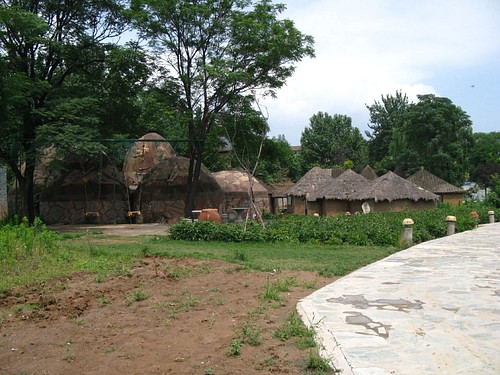
However one interprets this data (the Chinese conclusions have been disputed by the international community), the solid evidence provided by other finds substantiates a very ancient lineage of hominids and human beings in China and a high level of sophistication in early culture. One example of this is Banpo Village, near Xi’an, discovered in 1953 CE. Banpo is a Neolithic village which was inhabited between 4500 and 3750 BCE and comprises 45 houses with floors sunk into the ground for greater stability. A trench encircling the village provided both protection from attack and drainage (while also helping to fence in domestic animals) while man-made caves dug underground were used to store food. The design of the village, and the artifacts discovered there (such as pottery and tools), argue for a very advanced culture at the time it was constructed.

Banpo Village, Xi'an, China

It has generally been accepted that the Chinese ‘Cradle of Civilization’ is the Yellow River Valley which gave rise to villages sometime around 5000 BCE. While this has been disputed, and arguments have been made for the more widespread development of communities, there is no doubt that the Henan province, in the Yellow River Valley, was the site of many early villages and farming communities.

In 2001 CE, archaeologists uncovered two skeletons “buried in a collapsed house, which was covered with a thick layer of silt deposits from the Yellow River. In the layer of deposits, archaeologists found more than 20 skeletons, an altar, a square, pottery, and stone and jade utensils” (Chinapage.org). This site was only one of many prehistoric villages in the area.

The First Dynasties

From these small villages and farming communities grew centralized government; the first of which was the prehistoric Xia Dynasty (c. 2070-1600 BCE). The Xia Dynasty was considered, for many years, more myth than fact until excavations in the 1960s and 1970s CE uncovered sites which argued strongly for its existence. Bronze works and tombs clearly point to an evolutionary period of development between disparate Stone Age villages and a recognizable cohesive civilization.

The dynasty was founded by Yu the Great who worked relentlessly for 13 years to control the flooding of the Yellow River which routinely destroyed the farmer’s crops. He was so focused on his work that it was said he did not return home once in all those years, even though he seems to have passed by his house on at least three occasions, and this dedication inspired others to follow him.WRITING DEVELOPED UNDER THE SHANG DYNASTY AS WELL AS BRONZE METALLURGY, ARCHITECTURE, & RELIGION.

After he had controlled the flooding, Yu conquered the Sanmiao tribes and was named successor (by the then-ruler, Shun), reigning until his death. Yu established the hereditary system of succession and thereby the concept of dynasty which has become most familiar. The ruling class and the elite lived in urban clusters while the peasant population, which supported the elite’s lifestyle, remained largely agrarian, living in rural areas. Yu’s son, Qi, ruled after him and power remained in the hands of the family until the last Xia ruler, Jie, was overthrown by Tang who established the Shang Dynasty (1600-1046 BCE).

Tang was from the kingdom of Shang. The dates popularly assigned to him (1675-1646 BCE) do not in any way correspond to the known events in which he took part and must be considered erroneous. What is known is that he was the ruler, or at least a very important personage, in the kingdom of Shang who, around 1600 BCE, led a revolt against Jie and defeated his forces at the Battle of Mingtiao.

The extravagance of the Xia court and the resultant burden on the populace is thought to have led to this uprising. Tang then assumed leadership of the land, lowered taxes, suspended the grandiose building projects begun by Jie (which were draining the kingdom of resources) and ruled with such wisdom and efficiency that art and culture were allowed to flourish. Writing developed under the Shang Dynasty as well as bronze metallurgy, architecture, and religion.

Ancient Egypt

Egypt is a country in North Africa, on the Mediterranean Sea, and is home to one of the oldest civilizations on earth. The name ‘Egypt’ comes from the Greek Aegyptos which was the Greek pronunciation of the ancient Egyptian name ‘Hwt-Ka-Ptah’ (“Mansion of the Spirit of Ptah”), originally the name of the city of Memphis. Memphis was the first capital of Egypt and a famous religious and trade center; its high status is attested to by the Greeks alluding to the entire country by that name.

To the ancient Egyptians themselves, their country was simply known as Kemet, which means ‘Black Land’, so named for the rich, dark soil along the Nile River where the first settlements began. Later, the country was known as Misr which means ‘country’, a name still in use by Egyptians for their nation in the present day. Egypt thrived for thousands of years (from c. 8000 BCE to c. 30 BCE) as an independent nation whose culture was famous for great cultural advances in every area of human knowledge, from the arts to science to technology and religion. The great monuments which ancient Egypt is still celebrated for reflect the depth and grandeur of Egyptian culture which influenced so many ancient civilizations, among them Greece and Rome.

One of the reasons for the enduring popularity of Egyptian culture is its emphasis on the grandeur of the human experience. Their great monuments, tombs, temples, and artwork all celebrate life and stand as reminders of what once was and what human beings, at their best, are capable of achieving. Although ancient Egypt in popular culture is often associated with death and mortuary rites, something even in these speaks to people across the ages of what it means to be a human being and the power and purpose of remembrance.THE WRITTEN HISTORY OF EGYPT BEGINS BETWEEN 3400 AND 3200 BCE WHEN HIEROGLYPHIC SCRIPT IS DEVELOPED BY THE NAQADA CULTURE III. 

To the Egyptians, life on earth was only one aspect of an eternal journey. The soul was immortal and was only inhabiting a body on this physical plane for a short time. At death, one would meet with judgment in the Hall of Truth and, if justified, would move on to an eternal paradise known as The Field of Reeds which was a mirror image of one’s life on earth. Once one had reached paradise one could live peacefully in the company of those one had loved while on earth, including one’s pets, in the same neighborhood by the same stream, beneath the very same trees one thought had been lost at death. This eternal life, however, was only available to those who had lived well and in accordance with the will of the gods in the most perfect place conducive to such a goal: the land of Egypt. 

Egypt has a long history which goes back far beyond the written word, the stories of the gods, or the monuments which have made the culture famous. Evidence of overgrazing of cattle, on the land which is now the Sahara Desert, has been dated to about 8000 BCE. This evidence, along with artifacts discovered, points to a thriving agricultural civilization in the region at that time. As the land was mostly arid even then, hunter-gatherer nomads sought the cool of the water source of the Nile River Valley and began to settle there sometime prior to 6000 BCE.

Naqada II pottery

Organized farming began in the region c. 6000 BCE and communities known as the Badarian Culture began to flourish alongside the river. Industry developed at about this same time as evidenced by faience workshops discovered at Abydos dating to c. 5500 BCE. The Badarian were followed by the Amratian, the Gerzean, and the Naqada cultures (also known as Naqada I, Naqada II, and Naqada III), all of which contributed significantly to the development of what became Egyptian civilization. The written history of the land begins at some point between 3400 and 3200 BCE when hieroglyphic script is developed by the Naqada Culture III. By 3500 BCE mummification of the dead was in practice at the city of Hierakonpolis and large stone tombs built at Abydos. The city of Xois is recorded as being already ancient by 3100-2181 BCE as inscribed on the famous Palermo Stone. As in other cultures worldwide, the small agrarian communities became centralized and grew into larger urban centers.

Ancient Rome

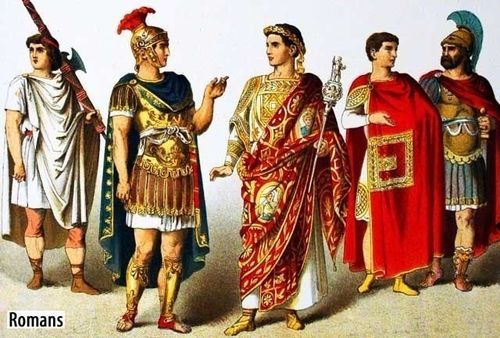
According to legend, Ancient Rome was founded by the two brothers, and demigods, Romulus and Remus, on 21 April 753 BCE. The legend claims that in an argument over who would rule the city (or, in another version, where the city would be located) Romulus killed Remus and named the city after himself. This story of the founding of Rome is the best known but it is not the only one.

Image result for ancient rome

Other legends claim the city was named after a woman, Roma, who traveled with Aeneas and the other survivors from Troy after that city fell. Upon landing on the banks of the Tiber River, Roma and the other women objected when the men wanted to move on. She led the women in the burning of the Trojan ships and so effectively stranded the Trojan survivors at the site which would eventually become Rome. Aeneas of Troy is featured in this legend and also, famously, in Virgil‘s Aeneid, as a founder of Rome and the ancestor of Romulus and Remus, thus linking Rome with the grandeur and might which was once Troy.

Still other theories concerning the name of the famous city suggest it came from Rumon, the ancient name for the Tiber River, and was simply a place name given to the small trading center established on its banks or that the name derived from an Etruscan word which could have designated one of their settlements. 

Ancient Greece

Greece is a country in southeastern Europe, known in Greek as Hellas or Ellada, and consisting of a mainland and an archipelago of islands. Ancient Greece is the birthplace of Western philosophy (Socrates, Plato, and Aristotle), literature (Homer and Hesiod), mathematics (Pythagoras and Euclid), history (Herodotus), drama (Sophocles, Euripides, and Aristophanes), the Olympic Games, and democracy. The concept of an atomic universe was first posited in Greece through the work of Democritus and Leucippus. The process of today’s scientific method was first introduced through the work of Thales of Miletus and those who followed him. The Latin alphabet also comes from ancient Greece, having been introduced to the region during the Phoenician colonization in the 8th century BCE, and early work in physics and engineering was pioneered by Archimedes, of the Greek colony of Syracuse, among others.

Mainland Greece is a large peninsula surrounded on three sides by the Mediterranean Sea (branching into the Ionian Sea in the west and the Aegean Sea in the east) which also comprises the islands known as the Cyclades and the Dodecanese (including Rhodes), the Ionian islands (including Corcyra), the isle of Crete, and the southern peninsula known as the Peloponnese.

THE GREEKS BECAME SKILLED SEAFARING PEOPLE & TRADERS WHO BUILT SOME OF THE MOST IMPRESSIVE STRUCTURES IN ANTIQUITY.

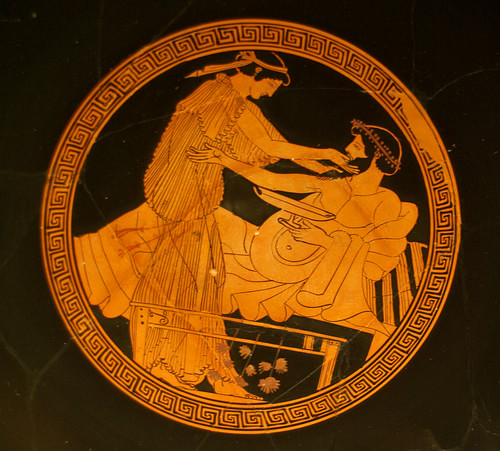
Image result for ancient greece

The geography of Greece greatly influenced the culture in that, with few natural resources and surrounded by water, the people eventually took to the sea for their livelihood. Mountains cover 80 percent of Greece and only small rivers run through a rocky landscape which, for the most part, provides little encouragement for agriculture. Consequently, the early ancient Greeks colonized neighboring islands and founded settlements along the coast of Anatolia (also known as Asia Minor, modern-day Turkey). The Greeks became skilled seafaring people and traders who, possessing an abundance of raw materials for construction in stone, and great skill, built some of the most impressive structures in antiquity.

Etymology of Hellas

The designation Hellas derives from Hellen, the son of Deucalion and Pyrrha who feature prominently in Ovid’s tale of the Great Flood in his Metamorphoses. The mythical Deucalion (son of the fire-bringing titan Prometheus) was the savior of the human race from the Great Flood, in the same way Noah is presented in the biblical version or Utnapishtim in the Mesopotamian one. Deucalion and Pyrrha repopulate the land once the floodwaters have receded by casting stones which become people, the first being Hellen. Contrary to popular opinion, Hellas and Ellada have nothing to do with Helen of Troy from Homer’s Iliad. Ovid, however, did not coin the designation. Thucydides writes, in Book I of his Histories:

I am inclined to think that the very name was not as yet given to the whole country, and in fact did not exist at all before the time of Hellen, the son of Deucalion; the different tribes, of which the Pelasgian was the most widely spread, gave their own names to different districts. But when Hellen and his sons became powerful in Phthiotis, their aid was invoked by other cities, and those who associated with them gradually began to be called Hellenes, though a long time elapsed before the name was prevalent over the whole country. Of this, Homer affords the best evidence; for he, although he lived long after the Trojan War, nowhere uses this name collectively, but confines it to the followers of Achilles from Phthiotis, who were the original Hellenes; when speaking of the entire host, he calls them Danäans, or Argives, or Achaeans.

Early History of Ancient Greece

Ancient Greek history is most easily understood by dividing it into time periods. The region was already settled, and agriculture initiated, during the Paleolithic era as evidenced by finds at Petralona and Franchthi caves (two of the oldest human habitations in the world). The Neolithic Age (c. 6000 – c. 2900 BCE) is characterized by permanent settlements (primarily in northern Greece), domestication of animals, and the further development of agriculture. Archaeological finds in northern Greece (Thessaly, Macedonia, and Sesklo, among others) suggest a migration from Anatolia in that the ceramic cups and bowls and figures found there share qualities distinctive to Neolithic finds in Anatolia. These inland settlers were primarily farmers, as northern Greece was more conducive to agriculture than elsewhere in the region, and lived in one-room stone houses with a roof of timber and clay daubing.

The Cycladic Civilization (c. 3200-1100 BCE) flourished in the islands of the Aegean Sea (including Delos, Naxos, and Paros) and provides the earliest evidence of continual human habitation in that region. During the Cycladic Period, houses and temples were built of finished stone and the people made their living through fishing and trade. This period is usually divided into three phases: Early Cycladic, Middle Cycladic, and Late Cycladic with a steady development in art and architecture. The latter two phases overlap and finally merge with the Minoan Civilization, and differences between the periods become indistinguishable.

The Minoan Civilization (2700-1500 BCE) developed on the island of Crete, and rapidly became the dominant sea power in the region. The term ‘Minoan’ was coined by the archaeologist Sir Arthur Evans, who uncovered the Minoan palace of Knossos in 1900 CE and named the culture for the ancient Cretan king Minos. The name by which the people knew themselves is not known. The Minoan Civilization was thriving, as the Cycladic Civilization seems to have been, long before the accepted modern dates which mark its existence and probably earlier than 6000 BCE.

The Minoans developed a writing system known as Linear A (which has not yet been deciphered) and made advances in shipbuilding, construction, ceramics, the arts and sciences, and warfare. King Minos was credited by ancient historians (Thucydides among them) as being the first person to establish a navy with which he colonized, or conquered, the Cyclades. Archaeological and geological evidence on Crete suggests this civilization fell due to an overuse of the land causing deforestation though, traditionally, it is accepted that they were conquered by the Mycenaeans. The eruption of the volcano on the nearby island of Thera (modern-day Santorini) between 1650 and 1550 BCE and the resulting tsunami is acknowledged as the final cause for the fall of the Minoans. The isle of Crete was deluged and the cities and villages destroyed. This event has been frequently cited as Plato’s inspiration in creating his myth of Atlantis in his dialogues of the Critias and Timaeus.

Design a site like this with WordPress.com
Get started