India is a country in South Asia whose name comes from the Indus River. The name ‘Bharata’ is used as a designation for the country in their constitution referencing the ancient mythological emperor, Bharata, whose story is told, in part, in the Indian epic Mahabharata. According to the writings known as the Puranas (religious/historical texts written down in the 5th century CE), Bharata conquered the whole subcontinent of India and ruled the land in peace and harmony. The land was, therefore, known as Bharatavarsha (`the subcontinent of Bharata’). Hominid activity in the Indian subcontinent stretches back over 250,000 years, and it is, therefore, one of the oldest inhabited regions on the planet.
Archaeological excavations have discovered artifacts used by early humans, including stone tools, which suggest an extremely early date for human habitation and technology in the area. While the civilizations of Mesopotamia and Egypt have long been recognized for their celebrated contributions to civilization, India has often been overlooked, especially in the West, though its history and culture is just as rich.
Prehistory of India
The areas of present-day India, Pakistan, and Nepal have provided archaeologists and scholars with the richest sites of the most ancient pedigree. The species Homo heidelbergensis (a proto-human who was an ancestor of modern Homo sapiens) inhabited the subcontinent of India centuries before humans migrated into the region known as Europe. Evidence of the existence of Homo heidelbergensis was first discovered in Germany in 1907 CE and, since, further discoveries have established fairly clear migration patterns of this species out of Africa. Recognition of the antiquity of their presence in India has been largely due to the fairly late archaeological interest in the area as, unlike work in Mesopotamia and Egypt, western excavations in India did not begin in earnest until the 1920s CE. Though the ancient city of Harappa was known to exist as early as 1842 CE, its archaeological significance was ignored and the later excavations corresponded to an interest in locating the probable sites referred to in the great Indian epics Mahabharata and Ramayana (both of the 5th or 4th centuries BCE) while ignoring the possibility of a much more ancient past for the region. The village of Balathal (near Udaipur in Rajasthan), to cite only one example, illustrates the antiquity of India’s history as it dates to 4000 BCE. Balathal was not discovered until 1962 CE and excavations were not begun there until the 1990s CE.ARCHAEOLOGICAL EXCAVATIONS IN THE PAST 50 YEARS HAVE DRAMATICALLY CHANGED THE UNDERSTANDING OF INDIA’S PAST &, BY EXTENSION, WORLD HISTORY.
Archaeological excavations in the past 50 years have dramatically changed the understanding of India’s past and, by extension, world history. A 4000-year-old skeleton discovered at Balathal in 2009 CE provides the oldest evidence of leprosy in India. Prior to this find, leprosy was considered a much younger disease thought to have been carried from Africa to India at some point and then from India to Europe by the army of Alexander the Great following his death in 323 BCE. It is now understood that significant human activity was underway in India by the Holocene Period (10,000 years ago) and that many historical assumptions based upon earlier work in Egypt and Mesopotamia, need to be reviewed and revised. The beginnings of the Vedic tradition in India, still practiced today, can now be dated, at least in part, to the indigenous people of ancient sites such as Balathal rather than, as often claimed, wholly to the Aryan invasion of c. 1500 BCE.
Mohenjo-Daro & Harappan Civilization
The Indus Valley Civilization dates to 5000 BCE and grew steadily throughout the lower Gangetic Valley region southwards and northwards to Malwa. The cities of this period were larger than contemporary settlements in other countries, were situated according to cardinal points, and were built of mud bricks, often kiln-fired. Houses were constructed with a large courtyard opening from the front door, a kitchen/workroom for the preparation of food, and smaller bedrooms. Family activities seem to have centered on the front of the house, particularly the courtyard and, in this, are similar to what has been inferred from sites in Rome, Egypt, Greece, and Mesopotamia.

The most famous sites of this period are the great cities of Mohenjo-Daro and Harappa both located in present-day Pakistan (Mohenjo-Daro in the Sindh province and Harappa in Punjab) which was part of India until the 1947 CE partition of the country which created the separate nation. Harappa has given its name to the Harappan Civilization (another name for the Indus Valley Civilization) which is usually divided into Early, Middle, and Mature periods corresponding roughly to 5000-4000 BCE (Early), 4000-2900 BCE (Middle), and 2900-1900 BCE (Mature). Harappa dates from the Middle period (c. 3000 BCE) while Mohenjo-Daro was built in the Mature period (c. 2600 BCE).
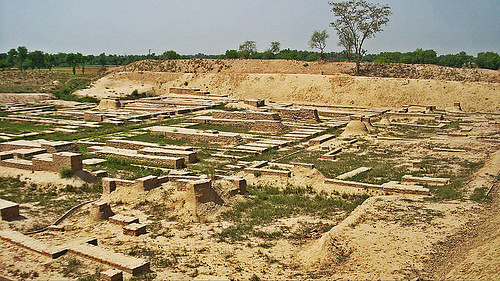
Harappa was largely destroyed in the 19th century CE when British workers carried away much of the city for use as ballast in constructing the railroad and many buildings had already been dismantled by citizens of the local village of Harappa (which gives the site its name) for use in their own projects. It is therefore now difficult to determine the historical significance of Harappa save that it is clear it was once a significant Bronze Age community with a population of as many as 30,000 people. Mohenjo-Daro, on the other hand, is much better preserved as it lay mostly buried until 1922 CE. The name `Mohenjo-Daro’ means `mound of the dead’ in Sindhi. The original name of the city is unknown although various possibilities have been suggested by finds in the region, among them, the Dravidian name `Kukkutarma’, the city of the cock, a possible allusion to the site as a center of ritual cock-fighting or, perhaps, as a breeding center for cocks.
Mohenjo-Daro was an elaborately constructed city with streets laid out evenly at right angles and a sophisticated drainage system. The Great Bath, a central structure at the site, was heated and seems to have been a focal point for the community. The citizens were skilled in the use of metals such as copper, bronze, lead, and tin (as evidenced by artworks such as the bronze statue of the Dancing Girl and by individual seals) and cultivated barley, wheat, peas, sesame, and cotton. Trade was an important source of commerce and it is thought that ancient Mesopotamian texts which mention Magan and Meluhha refer to India generally or, perhaps, Mohenjo-Daro specifically. Artifacts from the Indus Valley region have been found at sites in Mesopotamia though their precise point of origin in India is not always clear.
 Time travelling