Greece is a country in southeastern Europe, known in Greek as Hellas or Ellada, and consisting of a mainland and an archipelago of islands. Ancient Greece is the birthplace of Western philosophy (Socrates, Plato, and Aristotle), literature (Homer and Hesiod), mathematics (Pythagoras and Euclid), history (Herodotus), drama (Sophocles, Euripides, and Aristophanes), the Olympic Games, and democracy. The concept of an atomic universe was first posited in Greece through the work of Democritus and Leucippus. The process of today’s scientific method was first introduced through the work of Thales of Miletus and those who followed him. The Latin alphabet also comes from ancient Greece, having been introduced to the region during the Phoenician colonization in the 8th century BCE, and early work in physics and engineering was pioneered by Archimedes, of the Greek colony of Syracuse, among others.
Mainland Greece is a large peninsula surrounded on three sides by the Mediterranean Sea (branching into the Ionian Sea in the west and the Aegean Sea in the east) which also comprises the islands known as the Cyclades and the Dodecanese (including Rhodes), the Ionian islands (including Corcyra), the isle of Crete, and the southern peninsula known as the Peloponnese.
THE GREEKS BECAME SKILLED SEAFARING PEOPLE & TRADERS WHO BUILT SOME OF THE MOST IMPRESSIVE STRUCTURES IN ANTIQUITY.
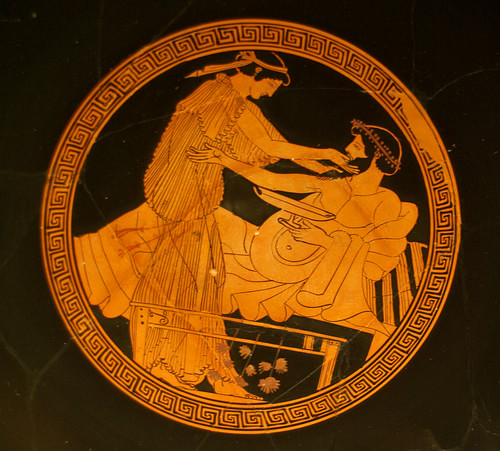
The geography of Greece greatly influenced the culture in that, with few natural resources and surrounded by water, the people eventually took to the sea for their livelihood. Mountains cover 80 percent of Greece and only small rivers run through a rocky landscape which, for the most part, provides little encouragement for agriculture. Consequently, the early ancient Greeks colonized neighboring islands and founded settlements along the coast of Anatolia (also known as Asia Minor, modern-day Turkey). The Greeks became skilled seafaring people and traders who, possessing an abundance of raw materials for construction in stone, and great skill, built some of the most impressive structures in antiquity.
Etymology of Hellas
The designation Hellas derives from Hellen, the son of Deucalion and Pyrrha who feature prominently in Ovid’s tale of the Great Flood in his Metamorphoses. The mythical Deucalion (son of the fire-bringing titan Prometheus) was the savior of the human race from the Great Flood, in the same way Noah is presented in the biblical version or Utnapishtim in the Mesopotamian one. Deucalion and Pyrrha repopulate the land once the floodwaters have receded by casting stones which become people, the first being Hellen. Contrary to popular opinion, Hellas and Ellada have nothing to do with Helen of Troy from Homer’s Iliad. Ovid, however, did not coin the designation. Thucydides writes, in Book I of his Histories:
I am inclined to think that the very name was not as yet given to the whole country, and in fact did not exist at all before the time of Hellen, the son of Deucalion; the different tribes, of which the Pelasgian was the most widely spread, gave their own names to different districts. But when Hellen and his sons became powerful in Phthiotis, their aid was invoked by other cities, and those who associated with them gradually began to be called Hellenes, though a long time elapsed before the name was prevalent over the whole country. Of this, Homer affords the best evidence; for he, although he lived long after the Trojan War, nowhere uses this name collectively, but confines it to the followers of Achilles from Phthiotis, who were the original Hellenes; when speaking of the entire host, he calls them Danäans, or Argives, or Achaeans.
Early History of Ancient Greece
Ancient Greek history is most easily understood by dividing it into time periods. The region was already settled, and agriculture initiated, during the Paleolithic era as evidenced by finds at Petralona and Franchthi caves (two of the oldest human habitations in the world). The Neolithic Age (c. 6000 – c. 2900 BCE) is characterized by permanent settlements (primarily in northern Greece), domestication of animals, and the further development of agriculture. Archaeological finds in northern Greece (Thessaly, Macedonia, and Sesklo, among others) suggest a migration from Anatolia in that the ceramic cups and bowls and figures found there share qualities distinctive to Neolithic finds in Anatolia. These inland settlers were primarily farmers, as northern Greece was more conducive to agriculture than elsewhere in the region, and lived in one-room stone houses with a roof of timber and clay daubing.
The Cycladic Civilization (c. 3200-1100 BCE) flourished in the islands of the Aegean Sea (including Delos, Naxos, and Paros) and provides the earliest evidence of continual human habitation in that region. During the Cycladic Period, houses and temples were built of finished stone and the people made their living through fishing and trade. This period is usually divided into three phases: Early Cycladic, Middle Cycladic, and Late Cycladic with a steady development in art and architecture. The latter two phases overlap and finally merge with the Minoan Civilization, and differences between the periods become indistinguishable.
The Minoan Civilization (2700-1500 BCE) developed on the island of Crete, and rapidly became the dominant sea power in the region. The term ‘Minoan’ was coined by the archaeologist Sir Arthur Evans, who uncovered the Minoan palace of Knossos in 1900 CE and named the culture for the ancient Cretan king Minos. The name by which the people knew themselves is not known. The Minoan Civilization was thriving, as the Cycladic Civilization seems to have been, long before the accepted modern dates which mark its existence and probably earlier than 6000 BCE.
The Minoans developed a writing system known as Linear A (which has not yet been deciphered) and made advances in shipbuilding, construction, ceramics, the arts and sciences, and warfare. King Minos was credited by ancient historians (Thucydides among them) as being the first person to establish a navy with which he colonized, or conquered, the Cyclades. Archaeological and geological evidence on Crete suggests this civilization fell due to an overuse of the land causing deforestation though, traditionally, it is accepted that they were conquered by the Mycenaeans. The eruption of the volcano on the nearby island of Thera (modern-day Santorini) between 1650 and 1550 BCE and the resulting tsunami is acknowledged as the final cause for the fall of the Minoans. The isle of Crete was deluged and the cities and villages destroyed. This event has been frequently cited as Plato’s inspiration in creating his myth of Atlantis in his dialogues of the Critias and Timaeus.
 Time travelling